Friday, September 10, 2010

Moroccan Faire

I always like things that have a double purpose, i.e. I like using things for everyday use that I decorate with and vice versa. Objects that are not only decorative but functional rate high in the savoir faire world. One such item is the Moroccan tea Glass. Here is something that is not only decorative but has a myriad of uses that is not just limited to drinking tea.

Tea plays a large part in Moroccan culture and traditionally the tea is served three times, and the amount of time the tea has been steeping gives each of the three glasses of tea a unique flavor, described in this famous proverb:

Le premier verre est aussi amer que la vie, The first glass is as bitter as life

le deuxième est aussi fort que l'amour, The second glass is as strong as love

le troisième est aussi doux que la mort. The third glass is as gentle as death.

Of course we would all like to spend time in a Moroccan Market buying our own, however they can be acquired very cheaply from a large variety of stores and suppliers. Usually known for their intricate designs and bright colours they are just perfect for decorating and other uses.
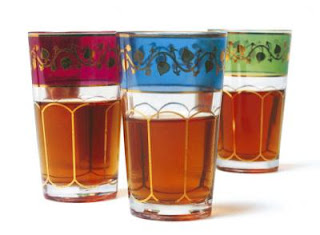
Build up sets of different colours for a truly vibrant and explosive look for display on shelves or table tops, or if the bright colours are not your thing , stick to a single colour. There are also truly elegant designs of clear glass with the most subtle of decorations in gold and other muted colours.


As mentioned before don’t just limited them to drinking tea out of. They are perfect for summer drinks or an aperitif before dinner.


They look fabulous with tea lights to create a truly intimate effect whether on the dinner table or around the home.


Deserts take on a whole new persona when served out of a tea glass.


Use them as vases for single flowers or planters to grow bulbs in such as the grape hyacinths below.


If the more traditional style is not your thing, there have been some modern adaptations as the ones below, which even though more modern in their approach, have not lost their charm.

Thursday, September 9, 2010

Dali Faire!

When one thinks of savoir faire in the art world, you cannot go past Salvador Dali. In everything he did he had immense personal style and savoir faire, which even extended down to his choice of pets. One of his favourites was an ocelot named Babou which travelled everywhere with him, whether across the Atlantic or out to dinner.

The below photo shows Dali and his private secretary Captain Moore in his cabin aboard the SS France prior to arrival in New York with Babou. This is full of surrealism and savoir faire, and would have appealed to Dali immensely.

An amusing story is how Dali with ocelot in tow were dining in a fashionable New York restaurant where Dali had tethered the animal to a leg of the table he was seated at while having dinner. A woman passed Dali and said ocelot and was horror stricken at the fact that a ‘wild animal’ was allowed in the restaurant.

"What is that?" she cried. "It's only a cat," Dali explained disdainfully. "I've painted it over with an op-art design." Looking again, (and recognising Dali) the woman sighed with relief. "I can see now that's what it is," she said. "At first I thought it was a real ocelot."

Wednesday, September 8, 2010

More Illustrated Savoir Faire

We are all familiar with the work of one of the most prolific graphic illustrators of the late twentieth century; however how many of us actually know the name behind some of the most iconic movie posters ever created?

The same artist was also responsible for a mountainous volume of advertising copy for various companies which embodied all the savoir faire of the 50’s, 60’s, 70’s and 80’s. In my humble opinion he could almost be the American equivalent of Rene Gruau.

The artist in question is Bob Peak, who has often been called the ‘father of the modern movie poster’. Singlehandedly he transformed the then traditional approach of movie advertising from basic collages of film stills or head shots to flamboyant artistic illustrations. His work included also included over 45 covers of Time with the most famous being his portrayal of Mother Teresa.


From advertising copy for companies such as Pepsi and Winston cigarettes to fashion illustration the Peak style is instantly recognizable. The subjects possessing all the savoir faire in the world as they use the featured product or wearing the featured clothes. Editorial illustrations were done for such magazines as Cosmopolitan and McCall’s.


TWA airlines commissioned posters, menus and magazine covers such as the ones below.


His movie poster career virtually took off when United Artists hired him to help promote west Side Story and the rest is history. The poster is a classic and recognized all over the world. Peak went on to create some of the most famous posters of the era including My Fair Lady, Funny Girl, Hair, Something Wicked This Way Comes, Apocalypse Now and countless others, with his final movie poster being for James Bond’s The Spy who Loved Me, which I copied in High School.


The illustrations themselves are glamorous; they also convey an idealized world which the rest of us aspired to. Some of the most famous names whether they are movie stars, politicians or just the man in the street have had the Peak treatment.

One of his greatest commissions was from US Post for 30 stamps commemorating the 1984 Olympics in Los Angeles


They don’t draw them like this any more!

Tuesday, September 7, 2010

Savoir Faire and the Art of Tea


As I mentioned in my last post before heading off to Montreal for the weekend, Montreal is a city of enormous savoir faire and always surprises me. A lot of French companies set up business there as their entrance into the North American market or just to serve the French speaking population.

One such company is Kusmi Tea. Walking along the Rue Saint Denis one afternoon I was drawn to a window display of fabulous coloured containers and upon closer inspection found that this was the Montreal headquarters of Kusmi Teas.

Founded in 1867 in St. Petersburg by Pavel Michailovitch Kousmichoff as a series of teahouses all over Russia. Kusmi then was then to become most famous for providing tea to the Russian royal court. Opening branches in London and Paris after the revolution and then between the wars opening offices in New York, Hamburg and Constantinople the business expanded.

The boutique is incredibly modern and decorated purely in white with splashes of red, which sets off the coloured labels of the Tea Tins and packaging perfectly.


The packaging itself is wonderful with the distinctive label in a variety of different colours shapes and sizes. We all know how much I adore packaging of anything and this does not disappoint. The label is distinctive blending traditional Russian backgrounds with up to date modern colours. One cannot help but notice it.


Over the years, fabrication of the exclusive blends has not changed: the meticulous selection of teas (from India, China and Ceylon), the confection of balanced and aromatic blends with the best natural essences from Grasse, Calabria and Madagascar. The Russian blends – made from a base of bergamot and citrus – created by the founder continue to be available and their recipes kept secret.


Needless to say I came away with the Russian sampler, a selection of 6 the Russian blends in the cutest little tins.

Thursday, September 2, 2010

Savoir Faire in Montreal

Savoir Faire is off to Montreal for the weekend for some much needed R & R. I am looking forward to it immensely for a number of reasons; one of them being that Montreal has a certain savoir faire that sets it apart from other Canadian cities.

Back in 1967 Montreal being the host of Expo 67 had all the savoir faire in the world. Originally awarded to the Soviet Union to commemorate the 50th anniversary of the Russian Revolution, they pulled out for reasons unknown. After much political backbiting within Canada, Montreal was the given the right to showcase the world’s best. This was also Canada’s main celebration during its centennial year.

Expo 67’s theme was “Man and his World” based on the 1939 book entitled Terre des Hommes by Antoine de Saint-Exupéry.

Expo featured 90 pavilions representing Man and His World themes, from nations, corporations, and industries including the U.S. pavilion, a geodesic dome designed by Buckminster Fuller. Expo 67 also featured the Habitat 67 housing complex designed by architect Moshe Safdie, which is still occupied.

Australia was duly represented with a pavilion set on steel and concrete pillars, and sloping walls of glass and aluminum to aid natural lighting.


Although not the most architecturally significant on the exterior at Expo it was a tour de force on the inside.


Visitors viewed large colour transparencies showing life in Australia mounted in a futuristic sculptural display as they proceeded by spiral ramp to view the exhibits.

In the main exhibit hall incredibly sculptural large curved wooden beams rose through the floor to the ceiling following the lines of the innovative air conditioning ducts which were funnels set into the ceiling. The whole are had off-white shag pile carpeting which swept from the floor up the walls, between the beams and to the ceiling.

This was Australia’s coming of age in the pop decade of the1960’s in design and style with the whole concept affectionately being nicknamed “Pop Goes Australia”

Specially designed seating with built in headphones told the story of Australia. Black Chairs for English and orange for French.

One could be forgiven for thinking that you were in some swish airport terminal such as Saarinen’s TWA terminal at JFK, however on a warmer scale with the wood and the carpeting.

21 hostesses under the supervision of a former Miss Australia met visitors to the Australian pavilion. Their uniforms consisted of fashionably short A-line sleeveless skimmers of Australian wool gabardine, with matching hip-length double-breasted jackets. Most of these young hostesses came from rural areas and had never been out of Australia so this was the trip of a lifetime, with their heads full of pride and glamour.


Of course with most of Expo’s buildings this was dismantled, however when visiting this weekend I am going to be thinking of when the world came to Montreal for some savoir faire and some young Australians represented their county with pride and savoir faire!
Blog Widget by LinkWithin