Sunday, May 22, 2011

The Power of Reflection!

I have always considered myself a reflective person in many ways. Remember the say that the 'eyes are the mirror of the soul' ? So being in a reflective mood and also short of inspiration and time to do a 'real' post, here are some mirrors to get you in the reflective mood or to mirror your soul.


Friday, May 20, 2011

Weekend Wear With Savoir Faire

I am a bit light on inspiration this week, due to a rather hectic schedule both at home and at work, which has seen me collapsing in a frazzled wreck in the evenings. However these clothes from Botegga Veneta are getting me inspired for a weekend of savoir faire!


Have a great weekend all!

Thursday, May 19, 2011

It all Started With a Sketch

We are all so familiar with the work of Yves Saint Laurent, that it has almost become part of fashion’s vernacular. Saint Laurent was one of the shining stars of Haute Couture in the twentieth century and it all began with a sketch.

In 1953, Saint Laurent submitted three sketches to a contest for young fashion designers, organized by the International Wool Secretariat. He won third place and was invited to attend the awards ceremony in Paris, in December of that year. While he and his mother were in Paris, they met Michel de Brunhoff, editor-in-chief of the Paris edition of Vogue magazine. de Brunhoff, was impressed by the sketches Saint Laurent brought with him and suggested he become a fashion designer.

Saint Laurent then pursued a course of study at the Chambre Syndicale de la Haute Couture. Again, Saint Laurent entered the International Wool Secretariat competition and this time won, beating out his friend Fernando Sanchez and a young German student named Karl Lagerfeld.] Shortly after his win, he brought a number of sketches to de Brunhoff who recognized in them close similarities to sketches he had been shown that morning by Christian Dior. Knowing that Dior had created the sketches that morning and that the young man could not have seen them, de Brunhoff sent him to Dior, who hired him on the spot.


I love fashion sketches as they are the germination of a couturier’s ideas into fully fledged collections. Saint Laurent was a prolific sketcher with him turning out 100’s of sketches per collection.

From even the most preliminary sketches his are easily recognisable with the finished product. The line and feel of each garment is perfectly represented by his sketches.

How I would love to have some of these and frame them as art, as this is what they are art. In this age of computer generated graphics and designs, these are a welcome relief that breathe life and savoir faire into the designer’s craft.


Wednesday, May 18, 2011

Autographed Savoir Faire!

With all the talk revolving around Cannes and the stars that attend, don't we long to see a star, such as the young Sophia Loren signing autographs in Cannes in 1961, with savoir faire.


Monday, May 16, 2011

Your Passport to International #$%@ Pleasure


Growing up in essentially a one horse town in outback Australia in the early seventies I had a constant stream of magazines and other sources which would fire my imagination. Glamorous far off locales and the jet-set was something that always inspired me, and I was very lucky that my family were great travellers.

Long before tobacco advertisements were banned from magazines one company’s ads always inspired me with their wonderful graphics and the phrase “your passport to International smoking pleasure”. Peter Stuyvesant ads had the most wonderful graphics that were entirely evocative of the era and the jet-set lifestyle.

I have no idea of who the artists were, however with their bold colours and images of airports and airliners they promised a lifestyle of savoir faire and sophistication. Promising Paris in the morning and New York in the afternoon the highly stylized images of airlines and airports pressed all my buttons.

Having never been a smoker, I would imagine that if was I would be smoking Peter Stuyvesant, just for the lifestyle.


Savoir Fact (Or Fiction)

Ah! Madame Rubinstein, how much did we really know about her? Everything we practically knew about her was either invented or embellished by Madame, so that it was hard to know where fact left off and fiction began. Read her autobiography and you would be forgiven for thinking that she was well born, well educated, and a genius where it came to the formulation of new skin care preparations. One thing was certain, however that she gave the illusion of all these things with savoir faire, as seen below in the series of photos of Madame, playing the role of chemist, in her laboratory and factory, or as he called them her ‘kitchens’.

Story goes according to Madame that she was born (we know that much, but when is under debate) in Cracow Poland (Fact) to a wealthy wholesale food broker (Fiction?). Her mother supposedly had a strong interest in feminine beauty and again taught her young daughter the important lessons of looking after one’s skin. Even more critical was the 12 jars of moisturizing cream from a chemist Jacob Lykusky (no records have been found for his existence) that she packed in her luggage when venturing forth to Australia in the later half of the 19th century. Supposedly after making her fortune in Australia she was able to ‘study’ with the best dermatologists and chemists that Europe had to offer. Whether she did or not the photographs below gives one the impression that Madame knew what she was doing and took a hands on approach that gave her company and advertising copy the personal touch. Women were more than happy to buy her products after seeing Madame at work.


Fact of fiction, she knew what she was doing when posing for photographs like these. She was selling an image and sell it she did!

Saturday, May 14, 2011

The Colour of White


“My life and fortunes are a monstrosity,”
“Partly because of Hera, partly because of my beauty.
If only I could shed my beauty and assume an uglier aspect
The way you would wipe color off a statue.”
moans Helen of Troy in a play by Euripides.

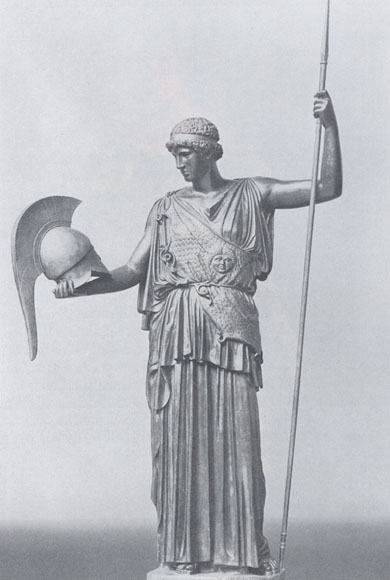
It seems that Helen has had her wish fulfilled, as when we think of classical Greek or Roman sculpture and architecture, we tend to imagine white marble. It is upon this assumption that we base our whole conception of classical sculpture and architecture on.

Take for example, that Caligula's handsome, marble face has stared out at a fascinated world for almost 2000 years. Now situated at the Ny Carlsberg Glyptotek museum in Copenhagen, the celebrated first-century bust of this cruel young Roman emperor is made repellent, yet intriguing, not so much by his petulantly downturned mouth as by the blank, staring eyes chiselled from marble by an unknown sculptor.

So, no doubt we are a bit surprised when confronted with an exact replica, with somewhat unthreatening hazel eyes garish pink skin and glossy brown hair. The bust now looks like one of those funny old mannequins you used to find in certain stores selling men’s hats or the like.

Scientists have now come to the conclusion that most likely many statues and buildings were actually painted and probably adorned with jewellery. A couple of years ago the Vatican Museum hosted an exhibition called “The Colours of White” of some of the most famous classical statues and antiquities with reproductions painted as close to the originals as they can , made possible because many statues contain trace amounts of pigment from their original coats of paint.

When most of these works were discovered, most of the paint had usually come off leaving us with a distorted view of what art was like in ancient times. Over time the idea of unpainted sculpture began to be propagated by art historians as correct/beautiful/preferred. If this is the actual case I'm sure that ancient Greeks and Romans would think it bizarre that later cultures left their sculptures white and unadorned all in the name of classicism.

Consider if Michelangelo's David had been painted. You can get an idea of what it might have looked like from this sculpture created after Michelangelo's David by a German artist, displayed in Cologne as part of the Museum Ludwig collection.

Art and art history could have been totally different than how they have turned out.

Ever since they became the object of scholarly interest, classical statues have been trapped in an aesthetic cage erected by the German scholar and father of modern archaeology, Johann Joachim

“Colored statues? To us, classical antiquity means white marble. Not so to the Greeks, who thought of their gods in living color and portrayed them that way too. The temples that housed them were in color, also, like mighty stage sets. Time and weather have stripped most of the hues away. And for centuries people who should have known better pretended that color scarcely mattered.”

“White marble has been the norm ever since the Renaissance, when classical antiquities first began to emerge from the earth…..Knowing no better, artists in the 16th century took the bare stone at face value. Michelangelo and others emulated what they believed to be the ancient aesthetic, leaving the stone of most of their statues its natural color. Thus they helped pave the way for neo-Classicism, the lily-white style that to this day remains our paradigm for Greek art.

Art and art history could have been totally different than how they have turned out, unless we take the cue from the artist who created the below statue using the discus thrower as inspiration!


Blog Widget by LinkWithin