Tuesday, October 4, 2011

Under the Weather

Apologies all for no comments on all your wonderful blogs and lack of posts on mine.

Sunday, October 2, 2011

The Baroness Had a Ball


It seems that nowadays there are none of the great private costume parties or balls held by the rich and famous as there used to be. Any party attended these days by the well to do and famous is usually sponsored by a multi- national corporation launching some product or movie. Nobody throws a great party for the sheer heck of it.

Gone are the great hostess’ of the last couple of decades of the twentieth century, and none knew how to throw a party more than Marie-Helene de Rothschild!

With savoir faire, and sheer determination she had the imagination to plan, create and hold grand soirees that would be constantly described as the best parties of the respective decade. With sheer ruthlessness she would attend to every detail ensuring complete success.

Forever in quest of new talent and new figures to entertain from the world of the arts, literature, dance and haute couture, she mixed them with the more established set of Paris society. Everyone was intrigued. Marie-Hélène's parties took on such importance that one social figure threatened to commit suicide unless she was invited...

One such grand fete was her Surrealist Ball held at her chateau Ferriéres, in December 1972.

Guests were asked to come in black tie and long dresses with Surrealist heads.

The invitation was printed with reversed writing on a blue and cloudy sky, inspired by a painting by Magritte. To decipher the card, it had to be held to a mirror.

For the evening the chateau was floodlit with moving orange lights to give the impression that it was on fire. The staircase inside was lined by footmen dressed as cats that appeared to have fallen asleep in a variety of staged poses.

To enter into the party Guests had to pass through a kind of labyrinth of Hell, made of black ribbons to look like cobwebs. The occasional cat appeared to rescue the guests and lead them to the tapestry salon. Here they were greeted by their hostess Marie-Hélène wearing the head of a giant donkey weeping tears made of diamonds.

Tables were decorated in a variety of surrealistic themes inspired by de Chirico, Magritte and Dali which shocked and astounded the guests for their originality.
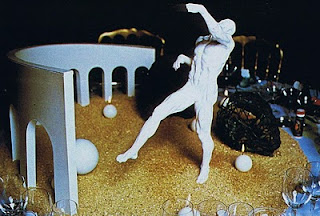
"It's a very healthy thing to give parties, don't you think?" she once said. "But people don't know how to dress any more - it breaks my heart. People have even lost the taste for perfumes. Nothing is done now for good taste or for the beauty of things, but to appeal to people's lowest instincts."

Thursday, September 29, 2011

Under The Sea With Evolution’s Controversial Artist

Ernst Haeckel was a professor of zoology in Germany from 1865 until 1909, who occasionally stooped to a bit of skullduggery to prove his theories. However the real area in which he stands out for me is his superb illustrations he created to illustrate his theories and work.

The published artwork of Haeckel includes over 100 detailed, multi-colour illustrations of animals and sea creatures that are extraordinary in their attention to detail. In a time before the camera was used to record detail we had Haeckel!


Jellyfish have never looked so good! Even though I am always impressed with the real thing, these just take my breath away!


In Savoir Faire's eyes these are sublime!

Tuesday, September 27, 2011

Does Your Savoir FAire Stand the Test of Time?

Well Savoir Faires, I am actually nearing 500 posts on this little blog! I never thought that I would get to this milestone as since when I started blogging I did not know where this would take me. That considered I thought I would show a bit of savoir faire through the ages, with just a touch of humour!

Below are some photos from a well known women’s magazine in Australia (which shall remain nameless). Each week they would have a feature called “What People are wearing’. It usually showed the society set, who had all the savoir faire in the world (for 1973 anyway) at various society functions generally being, glamorous, intelligent and oh so with it. While growing up in the middle of nowhere in Australia I used to read this section religiously .Just goes to show that what is considered the height of style one year is so terribly de trop the next.

Original captions from the magazine are with the photos.

‘Mr and Mrs Tony Richardson at The Sunday Painters Exhibition held by Committee Members of the Peter Pan Kindergartens at their Paddington Headquarters. Mrs. Richardson looks stunning in velvet flares and matching jacket.'

I guess Mrs. Richardson thought that this would never go out of style, and the fact that she was described as stunning kind of clinches the deal for me.

'Peta Oxer was a guest at the annual dinner dance held by members of the Avant Garde Committee at the Menzies Hotel (Sydney) in aid of Guide Dogs for the Blind. The Gold fish pendant Peta wore with her beautifully styled shantung dress added an unusual touch.'

The thing that I am wondering is that there was an “Avant Garde Committee” and that they had regular soirées like the one Ms. Oxer was attending and why wasn’t I invited?

'Mrs Kym Bonython wore a New Guinea tribesman's mask and an animal printed silk dress to the Night of Fantasy arranged by the Pied Piper Committee and held at the Elizabeth Bay home of the Cedric Symonds'

I am still wondering which museum she stole that mask from?

‘Mrs Helen Mullinger wore a domed yellow beret’. I think that this is all they could say on this particular entry as words just escape me.

Mrs Mullinger obviously had not considered what this would look like in September, 2011 where she has unwittingly found herself on a blog of do's and dont's about savoir faire.

Mr and Mrs George Hutchison were among the audience at the new Total Theatre when it opened with a production of Guys and Dolls. Mrs Hutchinson wore a silver fox stole with her red wool crepe dress. Her husband was in a black Kangaroo Coat.

PETA is still trying to track this couple down.

Mrs Dean Davies wore a yellow lace trimmed calico evening dress, matching scarf and beaded jewellery.

While everyone is looking fabulous, Mrs Davies is wondering where her next valium is coming from.

Mrs Shirley Barnett took second prize with the head-hugging helmet of silver, green and turquoise leaves she wore with her silk jersey gown'.

This is just before that head hugging helmet found its way into the trash. I wonder who got first prize?

So style mavericks, think carefully before posing on that staircase, cigarette and drink in hand, wearing chartreuse, think to yourself, “Is this going to stand the test of time?” Just as I ma asking myself will this blog stand the test of time?

Monday, September 26, 2011

America's Couturier

American fashion can sometimes be a bit of a conundrum. Always caught between the casual and chic and elegant, nothing really defines it like the glamour that is Paris or the style that is London.

There have really been few great American designers who have reached the lofty heights of sheer drop dead glamour. Mainbocher, James and Halston are up there, and so is Norman Norell. Now the name on people’s lips since First Lady Michelle Obama wore vintage Norell to a Washington Christmas Party in 2010, Norell is hot! Her choice is proving that great American fashion can be timeless.

Somewhat forgotten since his death in 1972, this in itself is telling in the negligence that coincides with the decline of the fashion industry in America. Known for his pret a porter which bordered on couture, Norell bought quality, taste and sophistication to a public that were yearning for this sort of cachet.

Receiving his initial training in New York at Parsons, he continued a strong relationship with the school right up until his death serving on the school’s advisory board and the Board of Trustees.


Norell was a central figure in the development of the American fashion industry from the 1940s through the early 1970s. His simple but stylish clothing was lauded for its glamour, timelessness, and high-quality construction. Considered the first American fashion designer to compete successfully with French couturiers a niche was carved out for the client who wanted to be dressed in the height of fashion.

Gaining prominence during WWII because of the lack of communication that was available between France and America at the time, magazines such as Vogue and Harper's Bazaar began to feature more American designers and Norell was one of them.

Norell's aesthetic is known for its precision tailoring, simplicity, and elegant femininity. . Innovative techniques and designs associated with him include the “Mermaid Dress”, a formfitting sequined evening sheath; evening and feminine variations on the pea coat; blouses and dresses with floppy bows tied under the chin, jeweled or contrasting buttons that added punch to an otherwise impeccably restrained ensemble; warm and rich looking fur and coat weight wool pants.

His “Subway Coat” which from the outside looked like a well cut conservative wool overcoat but when opened revealed a glorious sequined lining, perfect for riding on the subway en-route to a cocktail party or nightclub.

The designer’s talent was recognized in 1943 when he received the first Coty American Fashion Critics Award ever presented. He was to be awarded four more such awards, and in 1956, he was inducted into the Coty Hall of Fame.

America, needs more designers like this.


Sunday, September 25, 2011

Chez Dior

Recently as Savoir Faire followers will recall I featured the country retreat of the famed couturier Christian Dior. The mill which Dior had renovated was an exerecise in country living at its most refined and simplicity.


In stark contrast to this idyllic country retreat, Dior’s Paris apartment was an essay in high Napoleonic style and Parisian chic.

As Dior’s success gained momentum in the late 1940s and early 1950s, Dior had two friends decorate his Paris apartment in a style that was befitting his new status amongst Paris’ elite.

Georges Geffroy did the “public” rooms where Dior would hold receptions and dinners, while his other friend Victor H. Grandpierre did his private rooms.
One aspect of these rooms that strikes us is that they are virtually timeless in their appeal and execution. Today the colour pallet might be on a more muted tone, however I could see many designers using these rooms as a basis for designs today.

Thursday, September 22, 2011

Watermelon Cocktails at Schiaparelli

If you thought watermelon was only a fruit and are bemoaning the fact that summer is nearly over and that you will not be able to enjoy this luscious fruit until next year, well think again! Have some longing glances at these wonderful “watermelon” stones from Schiaparelli.

“Watermelon” rhinestones are multi-hued rhinestone called 'watermelon' because the stones resemble the natural watermelon tourmaline. Green around the edges and bright pink at the center.

Schiaparelli along with her arch nemesis Chanel promoted the use of cocktail jewellery also known as costume jewellery. Production of fine estate style jewellery was halted in the Second World War and America became the leader in designing attractive costume jewellery pieces using advanced technical methods of production making a market that was dynamic, inventive and affordable.


Whereas Chanel’s style harked back to baroque splendour imitating real jewellery (perhaps due to insecurity re her humble beginnings), Schiaparelli’s style reflected her aristocratic background and her never ending quest for the avant-garde and new.

Watermelon stones were among the most recognised and favoured of Schiaparelli’s jewellery. Set in anything from antique silver plate scrolls to rococo gold, these pieces are bold and showy, complimenting her signature shocking pink perfectly. Reflecting light like the colour of rainbows or opals the settings showcased these fakes wonderfully!


Watermelon has never looked so good!


Blog Widget by LinkWithin